
(Behag)

Description
This rag is very popular. Some common songs in Bihag are “Boliye Surali Boliyan”, “Hamare Dil Se Na Jana Dhokna Na Khana”, and “Tere Sur Aur Mere Geet”. It is a late night rag (9:00pm-midnight) of audav-sampurna jati. Its strong characteristic is the use of both madhyams. Opinion differs as to which Ma should be given prominence. The orthodox approach is to give importance to the shuddha Ma. However, more modern interpretations tend to give importance to the tivra Ma. It is this emphasis on tivra Ma which causes some musicians to assign this rag to Kalyan that.
Bihag has a moderately complex structure. This is due to the large number of rags which use both madhyams. One must pay particular attention to the pakad or else one may impinge upon Hamir, Yaman Kalyan, Kedar, or any of a number of related rags. The swarup (pakad) is Pa Má Ga Ma Ga. For those who still adhere to the vadi / samvadi theory, it has been suggested that the vadi is Ga and the samvadi is Ni. The Re and Dha are not used in the arohana but are used in the avarohana.
Arohana
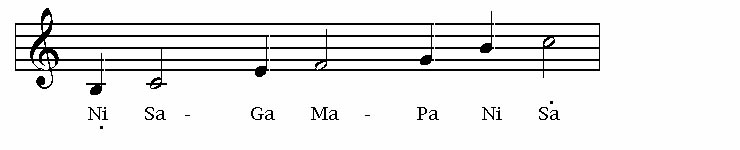
(general discussion of arohana) – (general discussion of notation)
Avarohana
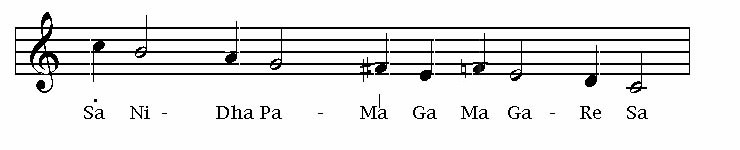
(general discussion of avarohana)
Jati
Audav-Sampurna – (general discussion of jati)
Vadi
Ga – (general discussion of vadi)
Samvadi
Ni – (general discussion of samvadi)
Time
Late night – (general discussion of time and rag)
That
Bilawal that – (general discussion of that)
Pakad
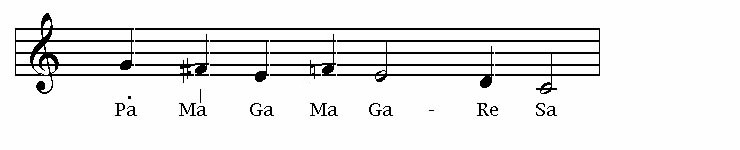
Drone
Sa – Pa – (general discussion of drone)
Popular Songs
For more information check out “Elementary North Indian Vocal: Vol 1” and “Elementary North Indian Vocal: Vol 2”
Selected Video
Other Sites of Interest
Indian Classical Music: Tuning and Ragas
Modes and Ragas: More Than just a Scale
Emotional responses to Hindustani Raga music: The role of musical structure
Automatic Raga Recognition in Hindustani Classical Music
Patrick Moutal. A Comparative Study of Selected Hindustānī Rāga-s based on Contemporary Practice
Automatic Tonic Identification in Indian Art Music: Approaches and Evaluation